
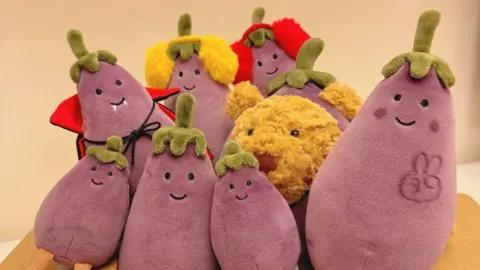
A woman named Stella acquired her first Jellycat soft toy in the midst of a time of unemployment during the global health crisis. Inspired by an acquaintance's passion for these British-designed toys, her curiosity was truly sparked when she saw an adorable gingerbread house plushie featured on a major Chinese social media platform.
While The Christmas holiday isn't traditionally observed in China, acting more as a commercial event than a religious festival, the imagery of festive cottages resonated to Stella. "The festival doesn't mean a lot for me... However, I always like the sight of those sweet houses," she explains. This led her to ask an old friend from her hometown to buy the item on her behalf.
That acquisition took place in 2021, right as the brand was about of achieving massive success in China and beyond. "Everyone felt uneasy, and nobody knew what exactly would happen," says Stella, who developed a habit of stroking and hugging her soft toys for comfort during a difficult period. Residing in Beijing, which experienced among the strictest lockdowns globally, she spent extended periods indoors.
Now 32 and working in sales manager in the tourism industry, Stella continues to expand her collection. Her collection has swelled to approximately 120 toys, with a total a cost of roughly 36,000 yuan. "As an adult, there are numerous matters you can't discuss with other people... and the troubles we encounter are far more complex than in the past," she says reflectively. "The plushies help me regulate my feelings."
Initially marketed for children, these soft toys have evolved into a global phenomenon, particularly in China where a somewhat disillusioned youth demographic has been seeking solace in them as a source of emotional support.
The Rise of Adult Toy Enthusiasts
Her gingerbread cottage plushie belongs to the "Amuseable" series, a set of toys with tiny faces modelled after everyday items, ranging from bathroom tissue and hard-boiled eggs. These plushies have become the "standout products" that "resonate with a broad younger adult audience" globally, as noted by industry analysts.
The surge in appeal "may have something to do with wanting to feel companiable," suggest cultural commentators. While it's difficult to say for sure whether the introduction of the now-iconic Amuseable line back in 2018 was an intentional strategy to engage the young adult market, toy manufacturers are under pressure to must find new markets due to declining birth rates in many countries.
Jellycat entered the Chinese market back in 2015. Having laid the necessary "foundation", the company was able to capture "the tone during Covid"—when individuals looked for comfort amid heightened uncertainty—and built on its early momentum there, according to business consultants.
Jellycat's fame was further propelled by creative pop-up experiences. These in-store activations sometimes offered a menu of exclusive "culinary" themed items. Numerous fans would film themselves interacting and share the clips on social platforms.
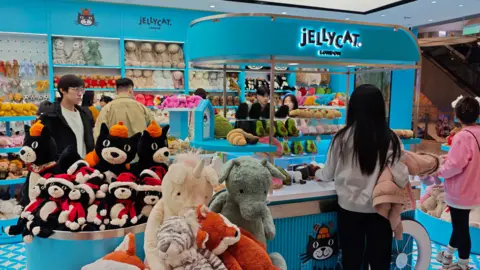
Localisation proved to be a core strategy. For instance, fans could purchase plush interpretations of traditional UK dishes like fish, chips and mushy peas at a temporary shop overseas. Conversely, products including teapot and teacup toys were sold at special stores in Beijing and Shanghai the previous year.
In 2024, the UK-based company's sales reportedly increased significantly to a substantial figure. In that timeframe, sales of roughly $117 million worth of toys to Chinese consumers via major online marketplaces, according to research estimates.
This expansion parallels a broader boom within China's collectable-toy sector driven by adult consumers seeking emotional comfort and connection. Overall sales from collectible toys in China are projected to exceed 110 billion yuan annually, as per a 2024 industry report.
The remarkable success of brands like Labubu, elf-inspired dolls by domestic company Pop Mart, highlights the country's growing demand towards designer collectibles. This "kidult" phenomenon isn't exclusive to China; young adults worldwide are increasingly question "outdated understandings of what it means to be an adult," note cultural experts.

Amuseables, especially the aubergine character—nicknamed "the boss" in China—have inspired numerous online jokes, with many sharing frustrations about adult life. The "eggplant boss" tag serves as a platform where people sketch different expressions on their toy, showing it in different states from drinking to forcing a smile.
As an illustration, a marketing professional from Hong Kong, Wendy Hui, modified her aubergine Amuseable adding bags around its eyes and putting spectacles on the toy. She then posted an image on a social platform with the caption: "The mental state of employees on Monday." "I kept working at home even on my days off," the 30-something says. "I just wanted to express how exhausted I felt."
In this way, Jellycat has become a surprising, light-hearted channel for young Chinese to voice their grievances about economic challenges, in which hard work doesn't always guarantee commensurate rewards. Amid strict online censorship, the internet remains a crucial, perhaps the primary, space for such conversations.
Its frequent releases of limited-edition designs coupled with the discontinuation of certain lines—a strategy sometimes referred to as "scarcity marketing" locally—has also driven {
